Manual · Chapter 5
Readiness & gaps
A number you can show your auditor: the readiness view measures how many applicable requirements are covered by released documents. Drafts don't count — which is exactly what makes the number trustworthy.
All screenshots show sample data from Berger Präzisionsteile GmbH — a fictitious company (CNC precision manufacturing, 12 people) used to show every easo feature honestly, open gaps included.
An honest percentage
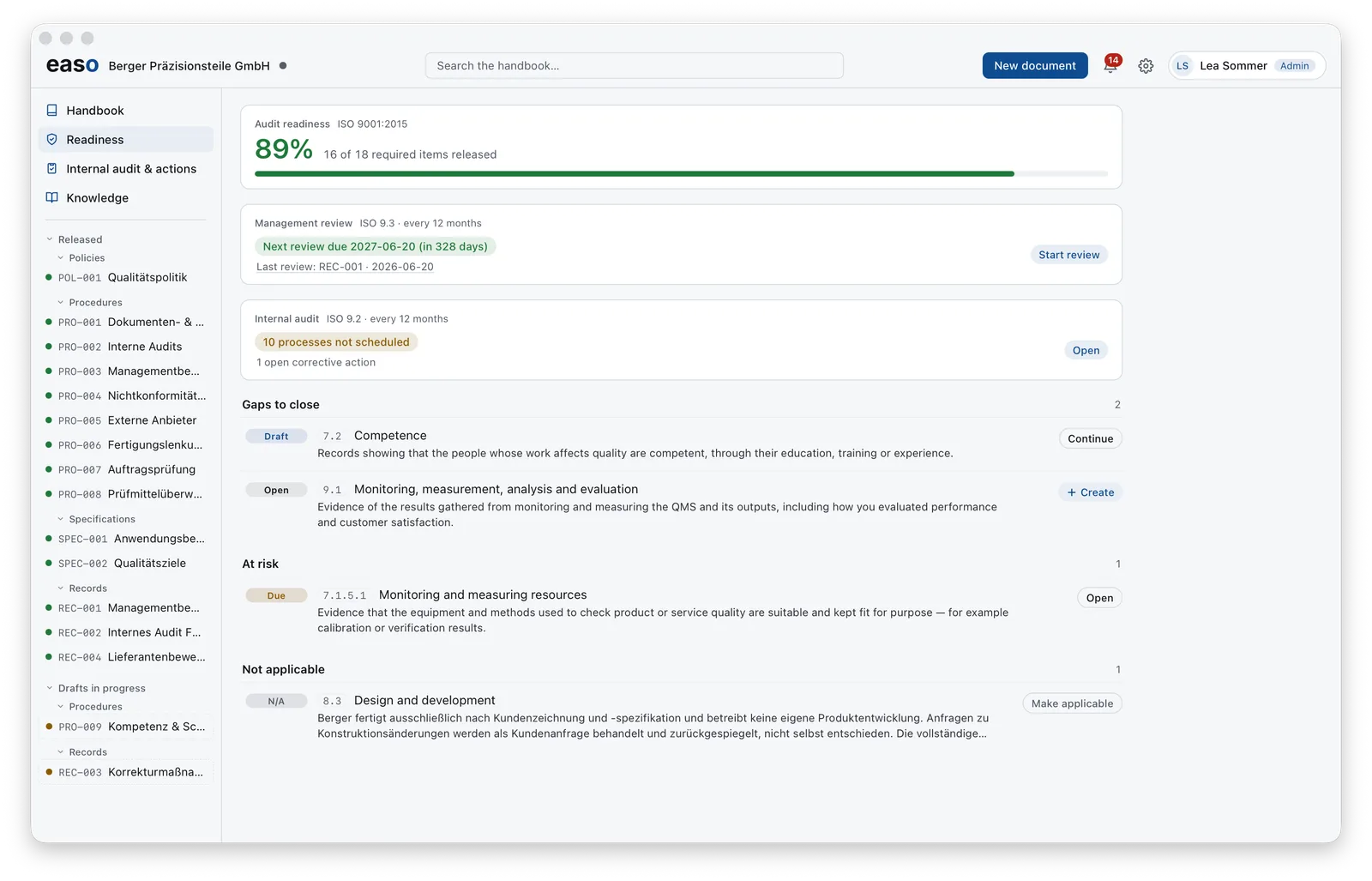
Berger stands at 89 % — 16 of 18 applicable requirements covered by released documents. The rest isn't a vague remainder; it's listed by name: what's missing, what's due, what was excluded with a justification. A QMS that starts at 100 % would be lying; one that knows its gaps is ready for an audit.
What the view tells you
Beneath the number sit the things that make a QMS alive: the next management review with its due date, the state of the audit programme, open corrective actions. For Berger, the whole honest picture is one glance: the procedure for 7.2 is still a draft (an open gap), clause 8.3 is excluded with a justification — Berger doesn't do design — and one document is past its review date.
Every row is a jumping-off point: click the gap, finish the draft, release it — the number follows. What the standard actually requires is explained in ISO 9001, explained clearly.